

Calgary vs. Edmonton: What July’s Rental Data Tells Alberta Landlords
Aug 7th, 2026
Rental market headlines often make it sound as though rents are moving in one direction across an entire province. July’s numbers tell a more complicated story.
Calgary and Edmonton continue to operate at noticeably different price points, but the differences go beyond which city commands higher rent. Furnished and unfurnished properties are moving differently, one bedroom rental trends have shifted from last year, and pricing varies considerably depending on where a property is located within each city.
For Alberta landlords and real estate investors, that distinction matters. A citywide average can provide a useful benchmark, but it cannot tell you what an individual rental property should achieve.
The July data offers a useful snapshot of where Calgary and Edmonton stand and, more importantly, why landlords need to look beyond the headline number when making rental pricing decisions.
Calgary vs. Edmonton: Where Are One Bedroom Rents in July 2026?
Calgary continues to command higher average one bedroom rents than Edmonton.
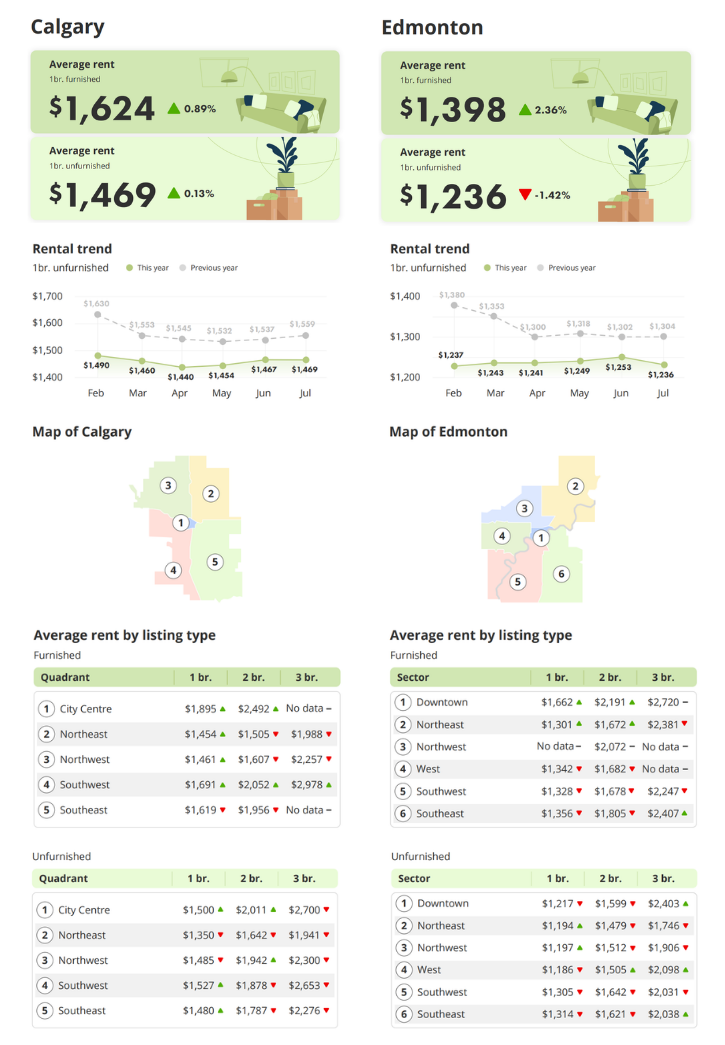
In July, the average furnished one bedroom rental in Calgary was $1,624, compared with $1,398 in Edmonton. That represents a difference of $226 per month.
The gap is slightly larger in the unfurnished market. Calgary's average unfurnished one bedroom rent was $1,469, compared with $1,236 in Edmonton, a difference of $233 per month.
But the percentage changes tell another part of the story.
Calgary's furnished one bedroom average increased 0.89%, while its unfurnished average increased 0.13%.
Edmonton's furnished one bedroom average increased by a stronger 2.36%, while its unfurnished average moved in the opposite direction, declining 1.42%.
That divergence is important.
It demonstrates why saying "rents are rising" or "rents are falling" can be misleading. The answer depends on the city and the particular segment of the rental market being considered.
Are Calgary and Edmonton Rents Actually Rising?
Month to month changes are useful, but landlords should also consider the broader trend.
Calgary's average unfurnished one bedroom rent was $1,490 in February. It moved to $1,460 in March, $1,440 in April, $1,454 in May, $1,467 in June and $1,469 in July.
Edmonton followed a different but similarly stable pattern. Its average unfurnished one bedroom rent was $1,237 in February, followed by $1,243 in March, $1,241 in April, $1,249 in May, $1,253 in June and $1,236 in July.
In other words, neither city has experienced a dramatic shift in unfurnished one bedroom rents over the past several months.
The year over year comparison shown in the infographic is more noticeable.
In July of the previous year, the chart shows an average unfurnished one bedroom rent of $1,559 in Calgary and $1,304 in Edmonton. This July, those averages are $1,469 and $1,236 respectively.
For property owners, this is a reminder that rental expectations should evolve with the market. What a property achieved previously does not automatically establish what it will achieve today.
Why Furnished and Unfurnished Rentals Are Telling Different Stories
One of the most interesting parts of July's data is the difference between furnished and unfurnished properties.
Furnished one bedroom rents increased in both cities, rising 0.89% in Calgary and 2.36% in Edmonton. Unfurnished rents, meanwhile, were nearly flat in Calgary and declined 1.42% in Edmonton.
The data does not tell us why those categories are moving differently, so landlords should be cautious about drawing conclusions about demand based on these figures alone.
What it does demonstrate is that furnished and unfurnished rentals should not be treated as interchangeable markets.
A landlord considering whether to furnish a property needs to look beyond the difference in advertised rent. Furnishings introduce additional upfront costs, replacement requirements, wear and tear considerations and management responsibilities.
The higher gross rent shown for furnished properties therefore does not automatically mean they produce a better return.
The relevant question is not simply, "Which option rents for more?"
It is, "Which strategy produces the strongest overall performance for this particular property?"
How Much Does Location Affect Rent in Calgary and Edmonton?
The geographic breakdown may be the most useful part of the July report for landlords.
Citywide averages can conceal significant differences between individual areas.
For example, furnished one bedroom rents in Calgary range from $1,454 in the Northeast to $1,895 in the City Centre.
In Edmonton, the available furnished one bedroom data ranges from $1,301 in the Northeast to $1,662 Downtown.
The unfurnished market shows a different pattern.
Calgary's July averages include:
- City Centre: $1,500
- Northeast: $1,350
- Northwest: $1,485
- Southwest: $1,527
- Southeast: $1,480
Edmonton's unfurnished one bedroom averages include:
- Downtown: $1,217
- Northeast: $1,194
- Northwest: $1,197
- West: $1,186
- Southwest: $1,305
- Southeast: $1,314
The difference between the lowest and highest averages within the same city can be substantial.
For landlords, this reinforces an important principle: your competition is not every rental property in Calgary or Edmonton.
A property should be evaluated against comparable rentals that prospective tenants are realistically considering alongside it.
Location is part of that equation, but so are property type, size, condition, parking, amenities, renovations, furnishing and overall presentation.
What Do Two and Three Bedroom Rental Prices Tell Property Owners?
The same geographic differences appear when looking at larger rentals.
In Calgary's unfurnished market, average two bedroom rents range from $1,642 in the Northeast to $2,011 in the City Centre. Three bedroom averages range from $1,941 in the Northeast to $2,700 in the City Centre, based on the areas where data is available.
Edmonton's unfurnished two bedroom averages range from $1,479 in the Northeast to $1,642 in the Southwest. Three bedroom averages range from $1,746 in the Northeast to $2,403 Downtown, where data is available.
The furnished category produces even wider variations in some areas.
For example, Calgary's furnished three bedroom average reaches $2,978 in the Southwest, while Edmonton's furnished three bedroom averages include $2,720 Downtown and $2,407 in the Southeast.
These numbers are useful benchmarks, but they should not be interpreted as automatic rental valuations.
Two three bedroom properties can perform very differently even within the same part of a city. Layout, property type, finishes, parking, outdoor space, utilities, amenities and overall condition can all influence how a rental competes.
Why the Highest Possible Rent Is Not Always the Best Rental Strategy
There is a natural temptation for landlords to focus on maximizing monthly rent.
But rental income is only valuable when the property is occupied.
Consider a simplified example.
Suppose a property can realistically rent for $1,500 per month, but the owner lists it at $1,600 hoping to capture another $100 per month.
If the higher price causes the property to remain vacant for one additional month, approximately $1,500 in potential rental income has been lost.
Even if the landlord eventually secures $1,600 per month, it would take 15 months of receiving that additional $100 just to recover the lost month of rent.
This is why experienced rental pricing considers more than the advertised monthly rate.
Vacancy exposure, comparable properties, current market conditions and the property's competitive position all need to be considered together.
What Should Alberta Landlords Take From the July Rental Data?
There are several practical lessons in July's Calgary and Edmonton numbers.
First, Alberta does not have one rental market. Calgary and Edmonton are operating at different price points, and different rental categories within each city are moving in different directions.
Second, monthly movement needs context. A percentage increase in one month does not necessarily indicate a sustained upward trend. Looking at several months of data provides a clearer picture.
Third, neighbourhood level data matters. The geographic differences within Calgary and Edmonton show why a citywide average should be treated as a benchmark rather than a rental valuation.
Fourth, last year's rent should not automatically become this year's asking price. Both Calgary and Edmonton's July unfurnished one bedroom averages sit below the previous year figures displayed in the report.
And finally, pricing should be based on the property's competitive position today. The objective is not simply to advertise the highest rent possible. It is to achieve strong rental income while managing vacancy and protecting the property's overall return.
How Market Knowledge Helps Protect Rental Property Performance
Rental market data is valuable, but numbers become more useful when combined with practical property management experience.
A landlord looking at an average rent cannot see from that number alone how quickly comparable properties are leasing, how their property's condition compares, whether its amenities justify a premium or whether its asking price is creating unnecessary vacancy exposure.
Those are property specific decisions.
At Davies Property Management, more than 42 years of property management experience has provided perspective through many different rental market cycles. That experience has reinforced the importance of evaluating rental properties individually rather than making decisions based solely on broad market headlines.
Our approach combines local market knowledge with established systems for rental pricing, marketing, tenant placement, maintenance and ongoing property management.
Davies is also proud to be a four time Consumer Choice Award winner, reflecting our long standing commitment to serving property owners and real estate investors.
Frequently Asked Questions About Calgary and Edmonton Rent Prices
What is the average rent for a one bedroom in Calgary?
According to the July 2026 data, the average unfurnished one bedroom rental in Calgary is $1,469 per month. The average furnished one bedroom rental is $1,624.
What is the average rent for a one bedroom in Edmonton?
The July data shows an average unfurnished one bedroom rent of $1,236 per month in Edmonton, while the furnished one bedroom average is $1,398.
Is rent more expensive in Calgary or Edmonton?
Based on the July figures shown in this report, Calgary has higher average one bedroom rents in both the furnished and unfurnished categories. An individual property's achievable rent will still depend on its location, property type, condition and features.
Are rents increasing in Calgary?
July's data shows furnished one bedroom rents in Calgary up 0.89% and unfurnished one bedroom rents up 0.13%. However, the six month unfurnished trend has been relatively stable, and July's $1,469 average remains below the previous year's $1,559 figure shown in the report.
Are rents increasing in Edmonton?
The answer depends on the rental category. Edmonton's furnished one bedroom average increased 2.36%, while its unfurnished one bedroom average declined 1.42% in July. The unfurnished average of $1,236 is also below the previous year's July figure of $1,304 shown in the report.
How should landlords determine the right rent for their property?
Market averages are a useful starting point, but landlords should compare their property with similar rentals based on location, property type, bedrooms, condition, amenities, parking, furnishing and other features. Vacancy risk should also be considered when deciding whether to test a higher asking price.
The Bottom Line for Calgary and Edmonton Rental Property Owners
July's rental data makes one thing particularly clear: there is more happening beneath the headline average.
Calgary continues to carry higher average one bedroom rents than Edmonton, but Edmonton's furnished category recorded the stronger percentage increase in July. Meanwhile, unfurnished one bedroom rents have remained relatively stable over the past several months in both cities and sit below the previous year figures shown in the report.
For landlords, the takeaway isn't that one city is "better" than the other.
It is that successful rental ownership requires understanding the market in which your individual property actually competes.
If you own an Edmonton or Alberta rental property and want a clearer understanding of its rental potential, contact Davies Property Management. With 42 years of experience, proven property management systems and deep knowledge of the Edmonton rental market, our team can help you make informed decisions designed to protect your investment and simplify rental property ownership.